
The
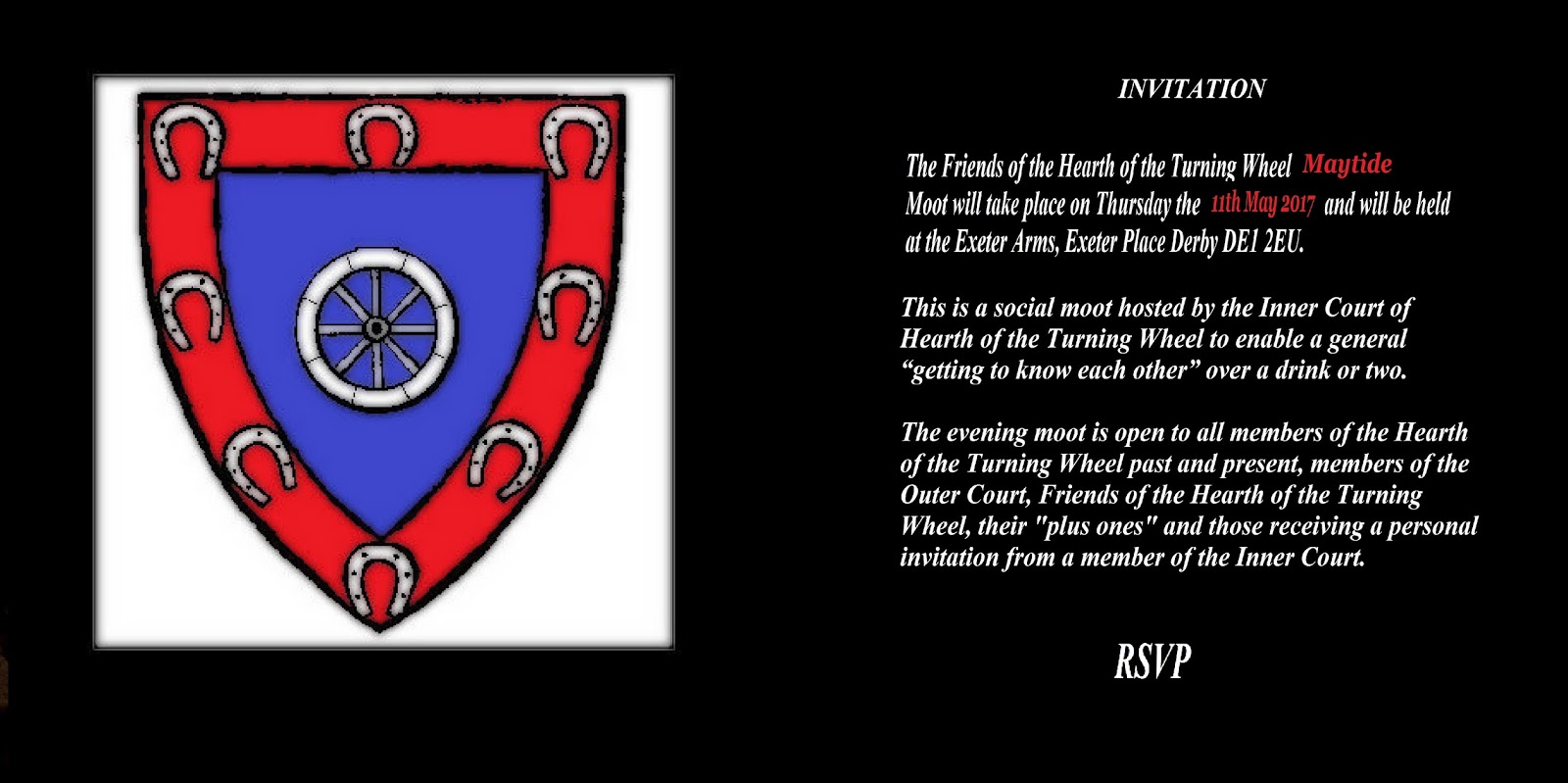
Maytide has been for the Hearth of the Turning Wheel, our Inner Court, Outer
and the Friends group, a rather mixed time. Our month started quietly with
little to report and our moot on Thursday 11th of May was a small, rather
intimate affair.
The
moot did provide me with the opportunity of a full dress rehearsal of my upcoming
presentation ‘Wheels within Wheels,’ affectionately known as ‘that Tarot
wheelie thing.’ My actual presentation is planned for Thursday the 8th
of June (2017) in the Upstairs Meeting Room of the West Riding (Pub), 38
Wellington Street, Leeds, LS1 2DE. I am the guest of the Ravens Rest Moot of
Leeds and a link to their Facebook group is below.
The
Ravens Rest Moot:
So
on the 11th of May after enjoying a very pleasant evening meal with
friends, I stood in the ‘Cottage’ of the Exeter Arms, which is the back room of
this rather charming pub and gave an informal run through of the talk to my
long suffering companions. It is rare that I get an invitation to speak
publicly, although I am no stranger to it and an opportunity to rehearse was
too good to miss. I consider it a matter of professional pride to prepare in
advance of any such public appearance.
The
‘Wheels in Wheels’ presentation began its existence, as an informal exposition
of interconnected calendar and seasonal symbolism. Written and presented to
clarify and explore the subject within the context of the Hearth of the Turning
Wheel, its creation was originally meant for the Hearth alone.

Since
becoming public it has become my most popular presentation and the Ravens Rest
Moot have specifically requested it. ‘Wheels within Wheels’ has been previously
presented at the Empyrean Pagan Interest Group in Nottingham, video clips are
available on You Tube (links below).
Wheels
within Wheels on You Tube:
Part
1: https://youtu.be/uO0fgJ2izjg
Part
2: https://youtu.be/mf9lKSc-974
Part
3: https://youtu.be/L3ds-MDEGRY

The
essential element of the presentation is the creation of what is best described
as a ‘mandala’ and this is done using tarot cards, rune cards and ogham cards.
Laid in concentric and overlapping circles, the rings formed aim to depict time
not as a ‘linearial’ concept but as a cyclic one. The visual display of solar,
lunar and seasonal rings illustrates the interconnectedness of the Great Wheel.
My
standing there, with my friends seated and laying a selection of cards on the
chosen cloth, did cause some puzzlement and curiosity. Passing staff had a
look, one or two thought we were playing a board game. An increasingly common
occurrence in pubs across Britain.
The
evening also enabled those present to discuss HTW business face to face, rather
than by email. Items on the agenda included our plans for the Summer Solstice
but one item of relevance (because of the approaching date), was our attendance
of the Castleton Garland Ceremony.

Castleton
is an attractive stone built village nestled in the Hope Valley, dominated and
perhaps under the shadow of Mam Tor (Mother Hill) and the castle rock ruins of
Peveril Castle. The village lies between Buxton and Sheffield, north of
Bakewell. The village is famous not only for the castle, the great Mother Hill
and the fine walking country. The hills are home of that rare and wonderful
fluorspar known as Blue John, its mines and that huge cavern, the Devil’s Arse
(Peak Cavern).

I
will not bore the reader with recapping further on the wonders of the Peak or
the history of the Garland Ceremony itself. Rather I suggest a look at a
previous report written after one of my earlier visits (link below).
A
Grand Day Out Castleton and the Garland Ceremony:

Our
decision was that car-sharing, we would make our way to Castleton on the
afternoon of Bank Holiday Monday, the 29th of May and meet others at
a designated point in Castleton. The journey however, proved to be surprisingly
eventful. The four of us heading north expected rain, the weather was quite bad
but meeting hail near Matlock was not at all expected. Trying to avoid the
expected traffic we cut off for the Buxton road and drove through the most
amazing low cloud, shrouding the Peaks for several miles this added an air of
mystery to the journey.

Heading
for Castleton on the north road we approached the famous Winnats Pass, a
winding, narrow road with visibility measured in car lengths. To our left and
right the land dropped away steeply, yet the valleys remained hidden by thick mist.
Entering the pass itself with its steep cliffs and sharp turns, the general
excitement was increased as we skidded on the wet surface of the road while
taking an unexpected bend. Only the skill and quick reactions of our driver,
the Defender of the Hearth, kept us on the road.

Our
designated meeting point was the primary carpark next to the visitor centre, lying
just outside of the old town defences. There after our usual greetings and a
general gathering of thoughts, the six of us set off to view the village. It
was late afternoon and the shops would soon be closing. The two early arrivals
had already had time to explore but this was an occasion for us late arrivals.
We also took the opportunity to purchase from a passing vendor, the necessary
oak sprigs. These are worn to show a traditional loyalty to the crown and the
money raised goes to charity.


Some
of the shops have the most magnificent displays of Blue John, these include
private collections displayed to delight the tourist and of course, to
advertise the outstanding skill of the local artisans. The collections include
a selection of priceless objects and enable the viewer to appreciate the
remarkable colour range of this fluorspar, which is unique to the region.


It
was unfortunate that the visitor centre was closed for renovation, so we did
not get to see the ancient stone head, believed to be a carving of the Goddess
Brigantia. This most venerable Goddess, is the nomenclature behind that of the
Celtic tribe that dominated the majority of this island in Roman times and it
is said, gave their own name to the island of Briton.


Across
the road from the visitor centre was the garage where the making of the King’s
Garland and the Queen’s Posey was based. So naturally we called to see the now
finished objects on display. The Garland today is created using a permanent and
therefore reusable metal frame, with a leather harness fitted beneath. In
ancient days it was a wicker structure that was made fresh each year.


The
garage itself was a miniature motor museum, we spotted some half dozen vintage
models, in various stages of repair, partially hidden under tarpaulins.
Unfortunately we could not get a closer look but what was visible to us,
intrigued and added to our enjoyment of the day.


Finding
that we had at least an hour before the main parade began, we headed for the
Bull’s Head to eat. Our choice of hostelry based primarily on the bronze stags
displayed in the window. They tempted me in. We took a table by the window,
ordered drinks and I was able to review an already enjoyable day. Two members
of the Inner Court, three members of the Outer and one Friend of the Hearth of
the Turning Wheel had made the trip. A very positive attendance and the main
event had yet to begin.


From
the window we were able to observe the riders and the band approach, post the
dressing of the Garland, as they made their way from the garage to the host pub
on the other side of the village. Finishing our drinks we made our way out to
join the assembled crowd, eventually catching up with the parade via an
unplanned detour into a traditional sweet shop. I bought fudge and Kendal Mint
Cake.


The
next hour was spent following the slow progression from pub to pub and watching
the charming dances performed by the local school children, accompanied by the
local brass band playing the traditional Floral Dance tune. I observed that
this year boys were permitted to join the dancing, an activity usually regarded
a female only preserve.


As
time was ever creeping on, we had to say goodbye as two of number chose to
depart. The journey across the Pennines in the mist was best avoided in
darkness. Those of us that remained set off to view the church in preparation
of the arrival of the Garland. In this late Norman church, that is dedicated perhaps
significantly to the Saxon Saint Edmund, are several points of interest. These
include a Norman Arch, a rare fragment of 14th century stained glass
depicting an angel and a collection of unusual Bibles. This collection includes
a ‘Vinegar Bible’ of 1717 and a ‘Breeches Bible’ of 1579. The box pews although
late are of interest, as many are carved with the names of local families. Indeed
the gravestones outside bear witness to these same local families, including
that famous name Eyre.


Gathering
outside we awaited the arrival of the ‘Royal Couple,’ King and Consort. Stopping
at the entrance to the churchyard, the King paused for the removal of the Queen’s
Posey, before riding alone up to the church tower. Here a rope was lowered from
the tower and the King’s Garland was hoisted off the shoulders of the rider, to
the delight of the crowd and amongst much cheering.


The
pinnacles of the church are decorated with the ubiquitous oak, save one central.
Once hoisted up the tower by strong men of the village, no machinery is used,
the King’s Garland is mounted upon that bare pinnacle. This is very much the
highlight of the event, although not the end of it and at least one member of our
companie was moved by this sight.


Leaving
the church behind us, we set off to find the hidden valley. Truly a surprise
for anyone who have not visited this village before, accessed through a cleft
in the cliffs and an incline, a delightful panorama opens. Cave Dale is a deep
valley of cliffs, dominated once again by the castle on one side. The sheer
cliff face serves to illustrate the remarkably strong strategic position, reminiscent
of Nottingham’s own Castle Rock.


Stretching
away into the distance, Cave Dale proper eventually opens out onto farmland and
a pleasant if challenging walk to Tideswell. Three of us decided to attempt a
climb up one side of the dale, hoping to reach a hallway point marked by a pinnacle.
We did not make it all the way, all choosing to turn back due at the three
quarter mark, due to the severe wet that was making the climb somewhat
treacherous. Although the adventure was not in any way sensible, it was rather
a lot of fun.


Returning
to the village, itself a treacherous descent on wet rock, we were in time to watch
some of the wonderful Maypole dancing. Again performed by the charming local
children, the dances are complex, intricate and delightful. Links to my own
video clips of the dances are below.
Castleton
Garland Day Maypole Dancing 2017
Part
1: https://youtu.be/4M5stnmg0N8
Part
2: https://youtu.be/BH4hsIwrW6c
Part
3: https://youtu.be/ZPRhAAFtdN8


The
mist caused by the low cloud was returning, not that it had ever truly lifted
and we judged this a good time to make our plans to leave. So leaving the
crowds at the war memorial where the Queen’s Posy was being laid, we had one
drink at the George before heading for the car. To paraphrase Falstaff, we decided
that discretion was the better part of valour and chose not to leave via
Winnats Pass. Rather we took the safer route, through the Hope Valley and
headed for Sheffield in search of the Chesterfield road.


So
ended another of our exciting Hearth trips, incorporating as they often do,
history, symbolism, humour and adventure. There are obviously social elements
to such trips, a valued opportunity for us to enjoy the company of friends but
there are other elements within. The Hearth of the Turning Wheel has a focus
upon the locality, the land about us, its myths and its legends. Visits to
sites and the observation of customs regional, enable us to reach out and touch
our land, our history and manifest our identity.


