Friday, 24 July 2015

DAY OF MYSTERIES AND MAGIC II (SATURDAY 25TH OCTOBER 2014) LEEDS UK

In October 2014 I travelled once again to the wonderfully vibrant and ever friendly city of Leeds. This was a weekend away to take in the Royal Armouries as an extra treat, complimenting the main reason for the journey, the second Day of Mysteries and Magic.


The event was organised by the West Yorkshire Pagan Meet-up Group, whose representatives Steve Jones and Gordon Mewse were in attendance to oversee the day. It was held at the Swarthmore Education Centre, a small but friendly venue just on the edge of the city centre proper and easy enough to find.

The event ran from twelve noon with an official end time of six in the evening, featured five talks or presentations covering a surprising variety with regard content and aimed at varying levels of knowledge. The event also incorporated a small but interesting Pagan themed market at the back of the hall.


The day began with a brief welcome from the organiser Steve Jones, who also made a presentation to his co-organiser Gordon Mewse. Mr Jones is the organiser and founder of a moot in Wakefield, which the longest running moot in the UK, he is also organiser of the West Yorkshire Meetup and a founder of the Oak Leaf Camp. So in organising events such as Day of Mysteries and Magic I and II, he is able to call upon a significant amount of previous experience.

With only a brief pause after the welcome address, Mr Jones deftly began his own presentation entitled ‘Masonic Wicca.’ In his presentation he expertly examined the historical links between Freemasonry and Gardnerian Witchcraft. Noting that Gardner was a Mason, that the three degree system and elements of the Wiccan initiation ceremonies, all have their counterparts in Freemasonry.

Equally Mr Jones was able to show that the term Blessed Be and the Five Fold Kiss, are derived from Freemasonry. In the last instance, the five points of the ‘Masonic Hug.’ It was also noted that the well-known ‘So mote it be’ of Wicca, is also found in Masonry being derived from a Jewish form of Amen.

The presentation was enlightening, educational and significant. Mr Jones had delivered this particular presentation only once before and that was at the Pagan Federation National Conference in 1999. His research at the time was considered pioneering and inspired several other authors to investigate further.

Steve Jones will reprise his presentation at Pagan Pride in Nottingham (UK) on the 2nd August 2015. Please see the link below.


The second presentation was by Tony Chapman who together with his wife Sue, runs the temple of Athame in Humberside. Mr Chapman is both a professional paranormal investigator of thirty years’ experience and a professional photographer. His presentation ‘Further in to the Paranormal World’ was wide ranging and informative. Starting with ghost sightings such as the Roman Legion of York, he covered apotropaic items such as animals and others, often found buried in older buildings.


Briefly mentioning saintly monks manifesting stigmatas, out of body experiences, divination and the Curse of Tutankhamun. He moved on to discuss the levitation of Daniel Douglas-Hume, cases of possession, the Witch Finder General and the famous medium Helen Duncan. Mr Chapman’s talk was essentially an exciting whistle stop tour of the weird and wonderful, peppered with anecdotes and observations from his varied career.


The third presentation was by Kai Roberts, a gentleman with several folklore works to his name and his presentation ‘Grave Concerns’ examined the history, significance and media hype of the alleged grave of Robin Hood at Mirfield Farm on the on Kirklees Priory Estate in Yorkshire. This presentation was of particular interest to me having written on the esoteric but not the historical significance of the Hood legend. That I leave to learned historians such as Mr Roberts.

Mr Roberts talk was highly in-depth and covered the history of the site from the earliest Hood associations that predate the introduction of Tuck and Marion, to the later and rather fanciful appearance of the Kirklees Vampire. This was a journey liberally mixed with historical references regarding the history of the Priory, its importance and influence before the final dissolution and the legendary associations.


In doing this Mr Roberts was able to provide an extensive range of citations from the Sloane manuscript, the writings of John Leeland and the letters of John Saville. Noting such important details as the 18th century introduction of the final arrow, that is not found in earlier sources, that the grave may have once born a cross of 13th century origin and that the epitaph itself, is very late and not at all original to the older parts of the structure.

The presentation ended with a discussion regarding two paranormal investigators, who each having their own theory relating to the Vampire, have engaged in energetic if completely pointless arguments on their respective BLOG sites. The audience could observe that rather than conduct research, each appeared far more interested in conducting themselves in a manner which would unavoidably damage their credibility.

The final conclusion was that although the historical Robin Hood is unlikely to be buried at Kirklees, the legendary and historical significance of the site sets it apart and that it therefore deserves preservation.

Kai Roberts has written a book looking at the Kirklees Grave in detail.


The penultimate presentation was from Mr Alan Millar, the Magister of the Milesian Order of Clanna Gadelus; a Traditional Craft cuveen sharing both Scottish and English roots. A professional music manager, publisher and author, Mr Millar is a well-known name in Craft circles and currently resides in Sheffield.

His talk ‘Forefathers of Modern Witchcraft’ provided us with an extensive catalogue of names from the early days of the Craft revival, covering Gardnerian, Alexandrian and Traditional Witchcraft. All the expected well-known names were all included but enough less public influences were provided, to keep the subject matter fresh and lively.


Mr Millar’s presentation is actually in two parts, reflecting the detail of the subject matter and due to obvious time constraints, we heard only the first section. This led to a post talk discussion that would most likely have contained elements of part two, as some of the questioning explored the more contemporary influences at play within Paganism and Witchcraft.

Mr Millar may be contact via the Witchcraft Research Network of which he is the founder: http://the-wren.webs.com/

The final presentation was by Mr Paul Bennett, author and Earth Mysteries Researcher, who with a highly extensive slide show titled ‘Standing Stones and Earth Mysteries, explored the Neolithic rock art of Yorkshire, the North of England and Southern Scotland. Here Mr Bennett drew cultural comparisons between cup and ring markings, rock carvings and various ancient monuments to illustrate the potential spread of ideas and even belief.

The slide show was wide ranging, covering the geographical areas mentioned discussing some officially undiscovered sites, while presenting a hypothesis for origin and context. The enormity of the research necessary to present the visual material was breath-taking.

Thrown into this heady mix were such observations as the near global occurrence of the Swastika, with examples in Europe dating from 18,000 BC. That there are 3000 petroglyphs in Yorkshire alone and that similarities in rock art found at Kilmartin in Scotland and |Newgrange in Eire, suggests both trade and communication.
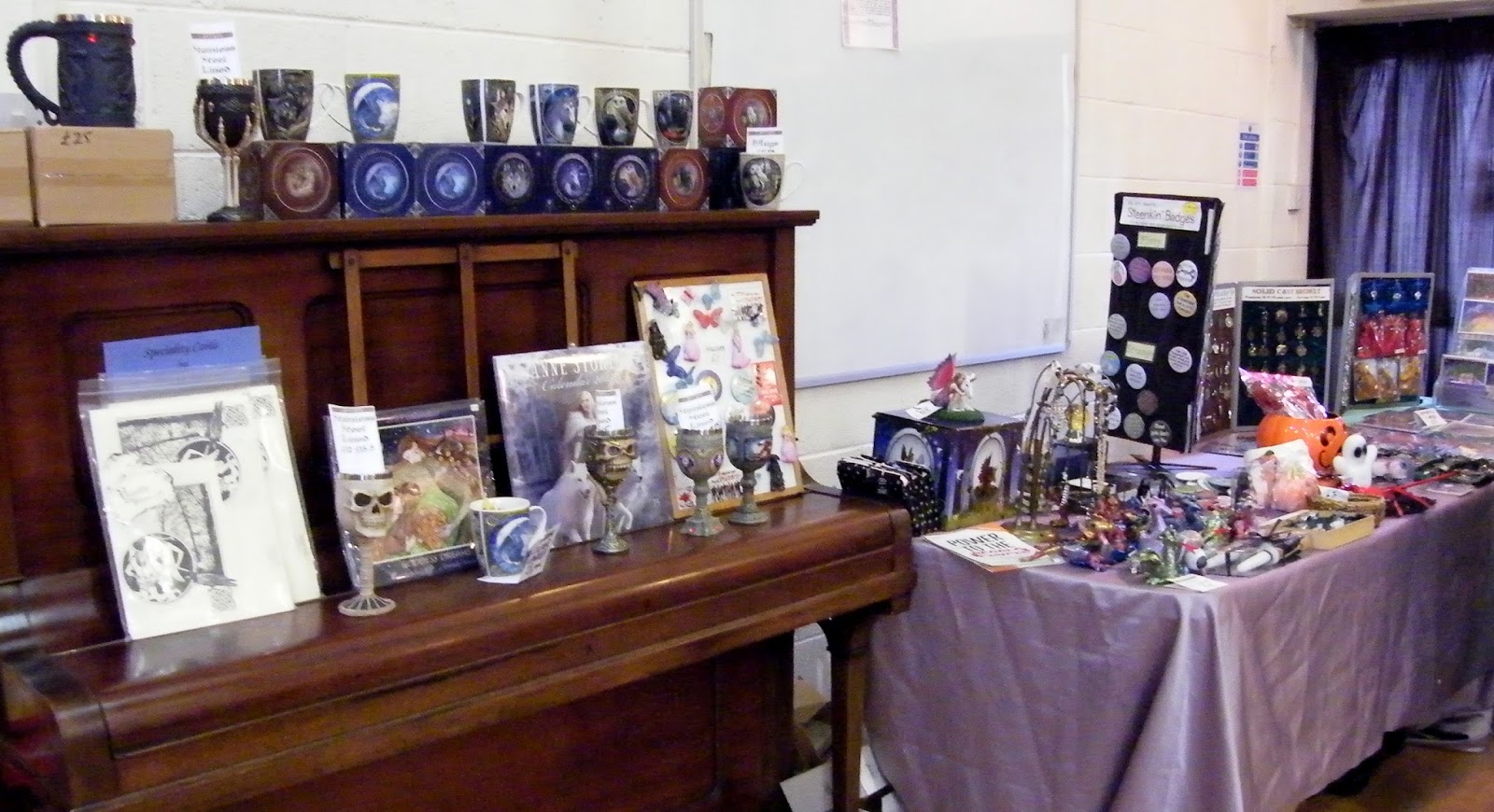


The second Day of Mysteries and Magic II was a highly enjoyable and informative event, a specialist and pleasant change from the more common MBS events that take place. I sincerely hope that one day, there will be a DM&M III.

Sunday, 19 July 2015

ROBIN HOOD: THE MAN THE MYTH BY TONY ROTHERHAM NOTTINGHAM EMPYREAN 1ST OCTOBER 2014


Empyrean as a lecture night has run in Nottingham for over twenty years now attracting some of the most credible, exhilarating and knowledgeable speakers in the Midlands. In October I attended the insightful and educational presentation by Doctor Tony Rotherham, one of several persons currently acting as an unofficial Robin Hood in Nottingham. Tony Rotherham is a man of considerable versatility himself, starting his career in 1978 he has a vast amount of television and film experience. He has appeared as an extra, while providing combat tuition and stunt work in over twenty films.

Having a doctorate in history he is an acknowledged authority upon the subject of the historical Robin Hood or perhaps we should say, Hoods. As from the historical perspective, we can deduce that there were many over the course of the later Medieval Period. Although some Robins may have been the peoples’ hero, the majority and certainly the earliest were not. The earlier Robins lived up to the title hood in a more modern sense, they were cutthroats and vicious robbers. Not necessarily anti-establishment figures or folk-heroes heading some localised peasants’ revolt.


In discussing the sentimentalisation of perceived anti-establishment figures, Doctor Rotherham touched upon the rather idealised and romanticised reinvention of not just Robin Hood but Dick Turpin, William Bonnie and the equally controversial Ned Kelly. In referring to the core elements of this sentimentalism, it is natural to refer back to the Victorian Romanticism of British history. Which at the time included the re-creation of the tartan, Scott’s Ivanhoe and his literary portrayal of Robin and ultimately, Victoria and Albert’s own romantic imagery.

To truly explore man, myth and history is was necessary for Doctor Rotherham to take us through a tangled yarn of mixed fibres, unpicking each mysterious weave and then knitting them back together, to produce numerous single threads, each worthy of research. This was done with consummate skill by an historian truly in love with his subject.

Throwing in such wonderful enigmatic names as Robert De Quirm, Fitzhugh and Fitzwarren, exploring alternative given names including the less glamourous Norbert, it soon became apparent that the man is obscured by myth and the mists of time. Was he minor nobility? How important were the Forestry Laws post the conquest? Why was he made an outlaw, literally worth six pennies if brought in dead, the enigmatic ‘wolfs’ head’ of the old laws.

Even the disputed origin of Lincoln Green, which I have heard some claim is actually Lincoln Grain, was explained and it is a term of much later origin than the historical Robin Hood. Taken from a white faced woodland sheep, bred for its meat. The fleece was poor, cheap and the woollen cloth died to that of a red brown colour. Possibly a more practical colour than actual green for a woodland outlaw or forester.

In English Law a forest is a managed hunting preserve and Sherwood at its height covered three hundred and seventy five square miles, a rich hunting ground for an enterprising outlaw. Connected or within reach of other forests, it is plausible that Hood and his one hundred and forty strong private army, could have dominated their own fiefdom, preying on the travellers frequenting the important trade routes through the forest of the time.

Since there existed a form of state compensation, in which the exchequer would reimburse the victim half of their losses, it should be no wonder that the authorities of the time wanted to end the outlaw threat. Here Doctor Rotherham makes an astute and much overlooked observation. At this time the historical Robin Hood, a vicious gangster type individual, would have been an indiscriminate threat to rich and poor alike. The real hero of the time was not Robin Hood but the maligned Sheriff of Nottingham and Derbyshire (the latter county was not important enough to have its own sheriff). Although one cannot help wonder if many false claims were made, after all who would know? I cannot imagine Robin Hood leaving the forest to say; “Well actually my Lord Sheriff, I did not rob him.”


The later romanticisation of the stories has changed the focus onto the Outlaw but historically, the Sheriff represented the powers of law and order. He was attempting to keep the peace and protect both person and property. In looking at the stories from this perspective, it is important to observe as did the good doctor, that for all their significance which cannot be ignored; the Robin Hood Ballads written quite late, are not an historical record. They cannot be accepted as historical evidence any more than we can regard a film starring Errol Flynn or Kevin Costner, as a documentary on life in Medieval England.

In looking at later variants of Robin Hood and his band, Doctor Rotherham briefly mentioned a female Robin taking a different role to that of Marion, who in the stories and plays, is of French origin, representing a conjoined symbolism of both the Virgin Mary and the Queen of the May.

Equally mention is made of the key figures from the Merry Men, meaning a household. So we have Little John or John Naylor, a maker of nails. William Scarlett or Scathlock, meaning redheaded. It is worth noting that both Naylor and Scarlett are common surnames in this area still.

We even have an early description of Robin Hood dating to 1210. He is a tall dark haired man, with a cruel scar running from the left eye to his mouth. This does not sound like the kind of person you would want to meet in a dark twitchel, never mind Sherwood Forest.

Although we have made mention of the Victorian Romanticism and Scott’s Ivanhoe, the change from common cut throat to folk hero appears to have come about in the fifteenth century but why? Although later Robin Hood figures may have been of a more sympathetic ilk than the earlier and may even deserve the to be seen as heroic defenders of the poor. This returns us to where we began, with other outlaws and why are they changed to represent anti-establishment figures? This question is left unanswered but does it recognise some primitive human need for such a hero? Is this why Robin Hood has endured, because you cannot pin him down, because he remains an outlaw, forever hunted but never found?


Doctor Tony Rotherham will be appearing at Pagan Pride Nottingham (UK) on the 2nd August 2015.


Saturday, 18 July 2015

I STAND NAKED BEFORE MY GODS (©1993)


I stand naked in my room, I am alone.
I cast my circle three times,
With my wand of rowan.
Once for the Maiden, once for the Mother,
And once for the Crone.

From the candle that I hold,
I light the four quarters.
I call upon the powers,
To guard the circle and witness my rite.

I invite my Gods to join me,
Caridwen and Cernunnos.
I am their child, I am their servant,
They are my Goddess and my God.
I am no longer alone.

I anoint myself with oil,
My forehead, my lips, my breast.
My hands and then my feet,
For I do walk the Pagan way.
I am a Witch.

I declare that I dedicate my life,
To the service of the Goddess and the God.
I am Pagan, I am with them,
I stand naked before my Gods.


First published in Hannon V.  (Ed.) (1993) Ghosts, ghouls and Witches.  Poetry Now of Peterborough. Photography ©the Chattering Magpie 2015.


Friday, 17 July 2015

THE PAGAN PRAYER


Ancient Gods, hear my prayer.
You who are the creators and guardians of all mankind.
You who gave the gift of life unto the universe.
To you I give my thanks for all the joys of life.
To you I give my praise for all those small things,
That I take for granted every day.

Grant your continued blessing unto your children.
Bring me health, wealth, love and joy.
Grant me your protection,
And forget not my loved ones.
Bring them love and joy and,
Grant them long life.
Let your shield be their protection.

O’ Ancient Gods, I salute you.
Bless your children, those that walk with you.
Hand in hand, unto the end of time.
Blessed be.


“The Pagan Prayer” first published as “The Pagan’s Prayer” in Fosket D.  (Ed.) (1996) Our psychic world.  Anchor Books of Peterborough.

Text copyright the Chattering Magpie.


Saturday, 11 July 2015

THE THUNDER PERFECT MIND (Translated by George W. MacRae)


“I am the one who is disgraced and the great one.
Give heed to my poverty and my wealth.
Do not be arrogant to me when I am cast out upon the earth,
And you will find me in those that are to come.

And do not look upon me on the dung-heap,
Nor go and leave me cast out,
And you will find me in the kingdoms.

And do not look upon me when I am cast out among those,
Who are disgraced and in the least places,
Nor laugh at me.

And do not cast me out among those who are slain in violence.
But I, I am compassionate and I am cruel.
Be on your guard!

Do not hate my obedience,
And do not love my self-control.
In my weakness, do not forsake me,
And do not be afraid of my power.

For why do you despise my fear,
And curse my pride?
But I am she who exists in all fears,
And strength in trembling.

I am she who is weak,
And I am well in a pleasant place.

I am senseless and I am wise.
Why have you hated me in your counsels?
For I shall be silent among those who are silent,
And I shall appear and speak,
Why then have you hated me, you Greeks?

Because I am a barbarian among the barbarians?
For I am the wisdom of the Greeks,
And the knowledge of the barbarians.

I am the judgment of the Greeks and of the barbarians.
I am the one whose image is great in Egypt.
And the one who has no image among the barbarians.

I am the one who has been hated everywhere
And who has been loved everywhere.”


A longer and slightly different translation can be found here:

The website of Peter van Staten can be found here:
http://www.petervanstraten.co.za/the-artist/


Thursday, 18 June 2015

Stanton Moor, the Vernal Equinox and the Partial Solar Eclipse: Friday the 20th March 2015


Here in the British Isles Friday the 20th March 2015 was the Vernal Equinox but the day was also astronomically significant for another reason. Across much of Northern Europe the same day would see a Partial Eclipse of the Sun. Even before the realisation of that last significant event, I had been invited by a party of friends to join them on a visit to the Nine Ladies Stone Circle, which stands on Stanton Moor in Derbyshire. I was also honoured by invitation of the host of the said group, to both write and lead an Equinox Ritual for his party. I was pleased to accept, knowing that I had made a positive impression on a previous occasion, when we had visited Lud’s Church in Staffordshire.

So it was that several friends and contacts began to consider the best or at least a suitable way of marking the dual event. My plan was to car share with a friend, drive to the edge of the moor and walk to the Nine Ladies to observe the event. There we would meet other friends including the party from Nottingham, picnic and perform a ritual for the Vernal Equinox.

Unfortunately due to matters beyond anyone’s control, we were a little late parking on the edge of the moor and were very much aware of a darkening sky as we drove into the Peak District. After a short walk from our parking space, we observed the Partial Eclipse not from the stone circle itself but from the cliffs overlooking the Derwent Valley and the villages below. A most beautiful prospect even with an overcast sky as we observed dancing shadows and speckled sunbeams move across the valley.

We observed the precise height of the Partial Eclipse standing amongst the rocks, a moment when enough cloud cleared to observe the sun safely and stand in awe as the Cheshire Cat from Alice's Adventures in Wonderland looked down upon us. Unfortunately I was unable to capture that moment, a very special moment photographically but we saw the moment and that was enough.

Moving on, my friend and I met up with a Facebook companion from the Derbyshire village of Brailsford, already settling down to picnic and appreciating the attractive surroundings of the stone circle. Joining her, we set our own equipment down and encamped far enough away from the stones to admire the setting, without encroaching upon the other visitors.

A text conversation soon ascertained that the party from Nottingham would not arrive until lunchtime and had observed the Partial Eclipse from the bus station in Derby. Apparently in Derby the skies were clear and not overcast at all, their views of the phenomenon were therefore, much better than our own.

We three merry campers on the moor set off to explore, take pictures and returned to our base for refreshments as necessary. As the morning lengthened, the skies cleared and the day became, bright and rather warm.

The Nottingham party eventually arrived, having themselves been delayed somewhere on the A6 road. My lift spent a few moments chatting but being aware of the time and having plans for the afternoon, was forced to depart. I chose to stay, as I had agreed to lead a ritual. This departure of my original lift did not however, leave me stranded. Our companion offered to give me a lift later to Brailsford, from whence home is easily accessible via public transport.


The Nine Ladies circle itself was empty and we were free to enter the circle for our ritual. We began the preparation for our observance with a minimalist approach to the equipment needed. I placed my stang in the north of the stone circle itself, four red painted horseshoes marked the compass points of north, south, east and west. I provided joss sticks, biscuits, a chalice of mead and a bottle of anointing oil, all of which was placed in the centre of the circle.

Printed scripts were handed out and volunteers sought for the various parts. Explanations were soon sought, the ritual was not what was expected. No circle casting for example, no this is a compass and the Nine Ladies is itself our circle. The elements are in the wrong places and again no, I am using a different model to the usual Golden Dawn or Wiccan inspired rituals, my inspiration is Robert Cochrane.

Once these matters were comfortably settled the ritual was underway and I reproduce the same, in its entirety below.


 The centring or grounding

Group gather in a circle and link hands, the Druid Oath is then intoned three times by all:

“We swear, by peace and love to stand
Heart to heart and hand in hand
Mark, O Spirit and hear us now
Confirming this, our sacred vow.”

One person shall say:

“Hail, Guardian Spirits of this place,
We ask for your blessings on this our rite.
We come here to celebrate the Spring Equinox.
We ask, in peace and with respect,
That you might accept our presence.”

(This is adapted from the Hearth of the Turning Wheel Alban Eilir Ritual written by K. Clegg and performed by the group in 2007)

The calling

Robin: “Beloved Bloodmother of this our clan. Welcome us at this time, with your heart and womb. Let us learn to live in love with all you are and so our seeking spirit shall serve the Sacred Blood.”

Marion: “Beloved Father, speak to us in vision and do not abandon us to the grave. Nor hand us over to Hard Fate utterly, nor those whom our love protects.”

All in unison: “We call thee, we call thee, we call thee. By flesh, blood and bone we call thee.”

Blessing and anointing with oil and incense

A suitable oil is blessed using wand, blade or hand while saying: “I do consecrate and bless this oil, to drive out all impurities and make fit for use in this our rite.”

Each person will anoint the person to their left with a runic symbol while saying: “You have walked this path in spirit (and) now (you) do so in flesh.” Please note that the words in brackets are optional.

For an Equinox or a Solstice the Hearth of the Turning Wheel use a version of the Sun rune:


 Light the incense, using wand, blade or hand bless and say: “I do consecrate and bless thee Oh elements of air and fire, to drive out all impurities and make thee fit for use in this our rite.”

Pick up the incense and say: “I scent this circle with air and warm this circle with fire. This I do in the name and power of our God the Lord of the Greenwood.” The compass points are scented, first north, then south, east and west.

Hallowing the compass: opening

Person “A” faces north and says: “From the sky, Crow Woman we call thee.”

Person “A” walks across the circle to face south and says: “From the earth, Hare Mother we call thee.”

Person “B” faces east and says: “From the rising sun, Goat King and Witchfather we call thee.”

Person “B” walks across the circle to face west and says: “From the underworld and the setting moon, Stag Lord we call thee.”

All in unison: “We call thee, we call thee, we call thee. By flesh, blood and bone we call thee.”

Central focus

One individual reads this poem (Adapted from Duff G. (2002) The wheel of the Wiccan year. Rider.):

“Ostara is new light, soft sweet air, the running hare and spring flowers.
The bursting of buds and the straight following of new paths.

May the spirits of the air guide our thoughts when we set out on new paths.

May the spirits of the Sun and fire give us vitality and passion to make new ventures successful.

May the spirits of water help us to tread new paths with balanced emotions.

May the spirits of the earth give us physical balance so we may draw life and health from the strengthening Sun.

May the Gods watch over us this Springtime and may we continually remember to give thanks to them for this new season.”

The rite of communion

The goblet and plate are held high while one individual reads this blessing from 'Sigdrifa’s Prayer' from ‘Sigdrifasmal.’

“Hail, day!
Hail, sons of day!
And night and her daughter now!
Look on us here with loving eyes,
That waiting we victory win.

Hail to the Gods!
Ye Goddesses, hail!
And all the generous earth!
Give to us wisdom and goodly speech,
And healing hands, life-long.”

The cup is passed to the left with the words: “May you never thirst.” The person receiving the cup will drink and pass the cup to their left with the same words.

The meal is passed to the left with the words: “May you never hunger.” The person receiving the meal will take some of that offered and pass the remainder to their left with the same words.

Hallowing the compass: closing

Person “B” faces west and says: “Of the underworld and the setting moon, Stag Lord we thank thee.”

Person “B” walks across the circle to face east and says: “Of the rising sun, Goat King and Witchfather we thank thee.”

Person “A” faces south and says: “Of the earth, Hare Mother we thank thee.”

Person “A” walks across the circle to face north and says: “Of the sky, Crow Woman we thank thee.”

All in unison: “We thank thee, we thank thee, we thank thee. By flesh, blood and bone we thank thee.”

Final closing

After a pause all in unison will say: “By the fire of dreams and the compulsion of sorcery. By knowledge, daring will and silence. By the tides of Earth, Sea and Sky. May all beings and powers of the visible and invisible depart in peace. By flesh, blood and bone we do thank thee.”

After a pause one person will say: “May all beings and powers of the visible and invisible depart in peace, with our blessings.”


Once the ritual had ended we again enjoyed our refreshments, some rest time and conversation. I was appreciative of the compliments made, as it was evident that the group enjoyed and were equally impressed by, both the ritual and my ‘performance’ as the Robin.


The Nottingham group eventually decided to set off and explore the moor proper. Stanton Moor itself, is famed for its beauty, its wildness and numerous Neolithic monuments. I on the other hand, knowing I had a private ritual to attend later that day, gratefully accepted a lift part of the way home.


References and further reading

Artisson R. (2006) The Witching Way of the Hollow Hill: the gramaryre of the Folk who dwell below the mound. Owlblink Bookcrafting Company USA.
Bellows H.A. (1936) (Trans.) The Poetic Edda. Forgotten Books.
Chattering Magpie (Griffith D.B.) (2010) Lammas ritual of sacrifice. Silver Wheel volume 2. Lear Books pp89-96.
Chattering Magpie (Griffith D.B.) (2010) For they who walk alone. The Hedgewytch: issue 51 August/Lammas 2010 pp31-34.
Chattering Magpie (Griffith D.B.) (2011) The Hearth of the Turning Wheel hallowing of the compass. Silver Wheel Volume 3. pp134-135.
Duff G. (2002) The wheel of the Wiccan year. Rider London.
Ellis Davidson H.R. (1964) Gods and Myths of Northern Europe. Pelican Books. London.
Ellis Davidson H.R. (1988) Myths and Symbols in Pagan Europe: Early Scandinavian and Celtic Religions. Syracuse University Press, NY. USA.
Fries J. (1993) Helrunar: a Manual of Rune Magic. Mandrake of Oxford, UK.
Gary G. (2008) Traditional Witchcraft: a Cornish Book of Ways. Troy Books, Penzance Cornwall.
Grey W. (nd.) cited by Jones E.J. (1990) Witchcraft: a tradition renewed. Robert Hale, London.
Gundarson K. (1990) Teutonic Magic: the Magical and Spiritual Practices of the Germanic Peoples. Llewellyn Publications, USA.
Howard M. (1994) Mysteries of the Runes. Capall Bann, UK.
Jackson N.A. (1994) Call of the Horned Piper. Capall Bann UK.
Jones E.J. Cochrane R. Howard M. (2001) The Roebuck in the Thicket: an anthology of the Robert Cochrane Witchcraft Tradition. Capall Bann UK.
Jones E.J. (1990) Witchcraft: a tradition renewed. Robert Hale, London.
Clegg K. (2007) The Hearth of the Turning Wheel Alban Eilir Ritual.
Larrington C (1996) (Trans.) The Poetic Edda. Oxford University Press.
MacRath-MacPhalrain Ailean (Craw Alan) (2004) Altar and Stang. The Wytches’ Standard magazine. Issue #1 Winter Solstice/Yule 2004.
Oates S (2011) Tubelo’s Green Fire: Mythos, Ethos, Female, Male and Priestly Mysteries of the Clan of Tubal Cain. Mandrake of Oxford, UK.
Oates S (2012) The Star Crossed Serpent II: the Clan of Tubal Cain the Legacy Continues: Shani Oates 1998 -. Mandrake of Oxford, UK.
Stewart R.J. (1992) The complete Merlin tarot. Aquarian/Thorsons London.
Valiente D. (1978) Witchcraft for tomorrow. Robert Hale, London.

Text copyright D.B. Griffith the Chattering Magpie 2013 - 2015; all artwork and illustrations copyright D.B. Griffith the Chattering Magpie and the Hearth of the Turning Wheel 2015.


Monday, 15 June 2015

Ecclesiastes Ch. 3 vs. 1-8 King James Bible 1611

Picture © the Chattering Magpie 2015

To everything there is a season,
And a time to every purpose under the heaven:
A time to be born and a time to die;
A time to plant and a time to pluck up that which is planted;
A time to kill and a time to heal;
A time to break down and a time to build up;
A time to weep and a time to laugh;
A time to mourn and a time to dance;
A time to cast away stones and a time to gather stones together;
A time to embrace, and a time to refrain from embracing;
A time to get and a time to lose;
A time to keep and a time to cast away;
A time to rend and a time to sew;
A time to keep silence and a time to speak;
A time to love and a time to hate;
A time of war and a time of peace.

Picture © the Chattering Magpie 2015